
How pro soccer grew in America: the clubs that changed the map
Follow the original NASL, modern men's and women's leagues, and development clubs. See how arrivals, moves and departures changed soccer's reach, then find your hometown's story.
A familiar crest appears in a new city. A team moves across town. A club leaves and the nearest option becomes much farther away. Those changes are the story behind the shaded counties on our soccer growth map.
The map opens with men's professional clubs and a timeline from 1996 to 2026. Select a club to see its reach, follow what changed that season, and compare the men's game, the women's game and the development clubs around them. The History starts selector also lets you go back to the original NASL in 1968, with visible gaps in the archive.
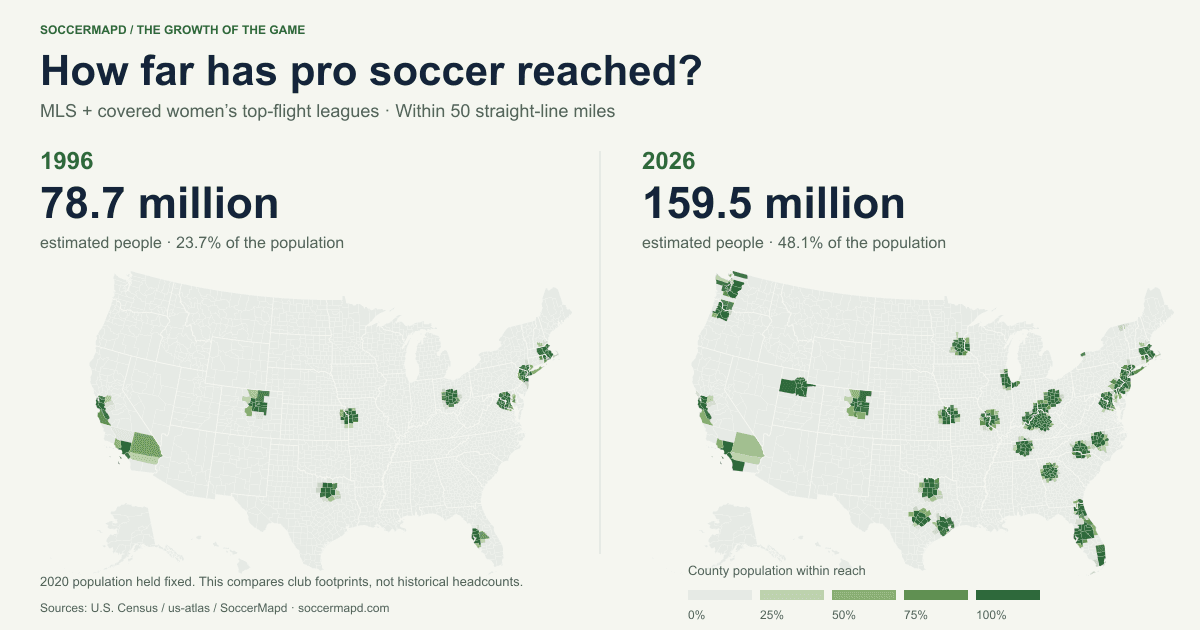
For one modern comparison, the combined men's and women's Top-flight pro view reaches an estimated 78.7 million people within 50 miles in the 1996 map and 159.5 million in the 2026 map, using that fixed population. That is 23.7% rising to 48.1%, or 80.8 million more people within the later footprint.
Go back to the original NASL
Set History starts to 1968 · Original NASL, then compare 1968, 1978 and 1984. Our original NASL archive records 17 outdoor clubs, then 24, then nine. That arc makes both expansion and contraction visible. The club names and locations help explain which regions gained nearby options and which lost them. U.S. Soccer's history of the NASL describes the league's growth and collapse.
Between the NASL and MLS: 1985–1995
The original NASL's final outdoor season was 1984, and it ceased operations in 1985. The professional game continued through regional outdoor leagues and indoor competitions. Several former NASL clubs joined the Major Indoor Soccer League (MISL), as U.S. Soccer's account of the league's aftermath explains.
Outdoor soccer also reorganized. In 1990, the WSL and ASL merged to form the American Professional Soccer League (APSL). MLS launched in 1996, giving the country its first men's top-division outdoor professional league since the NASL, according to U.S. Soccer's historical timeline.
Our 1985–1995 gap describes the archive's coverage. We have not yet included the season-by-season clubs and venue locations from those intervening leagues. The men's and combined views therefore leave population reach unmeasured, rather than reporting zero clubs or zero people nearby. The map's restart with MLS in 1996 marks the next measured chapter, while professional soccer had been continuing all along.
What does one club bring closer?
A selected club has two useful population measures. Its full reach counts everyone represented within the chosen radius. Its only-option count includes those with no other recorded club in range under the same filters. A second team in an already served city can offer another matchday choice while adding little to the national footprint.
Individual club catchments overlap, so adding their totals would count some people twice. Annual club gains can overlap too: two arriving teams might both reach the same newly covered community. The national figure counts that community once.
Follow arrivals, departures and recorded moves alongside these numbers. A departure means a team left the selected league view; it may have continued elsewhere. A better-researched location can also adjust the map, so location-record updates are distinguished from supported moves.
Compare the levels, then the women's game
Top-flight pro combines the original NASL with MLS and the recorded WUSA, WPS, NWSL and Super League seasons. All covered pro leagues adds USL Pro / Championship from 2011 and League One from 2019. Choose Pro + development to include League Two / PDL from 2011; those seasonal development teams are not another professional division.
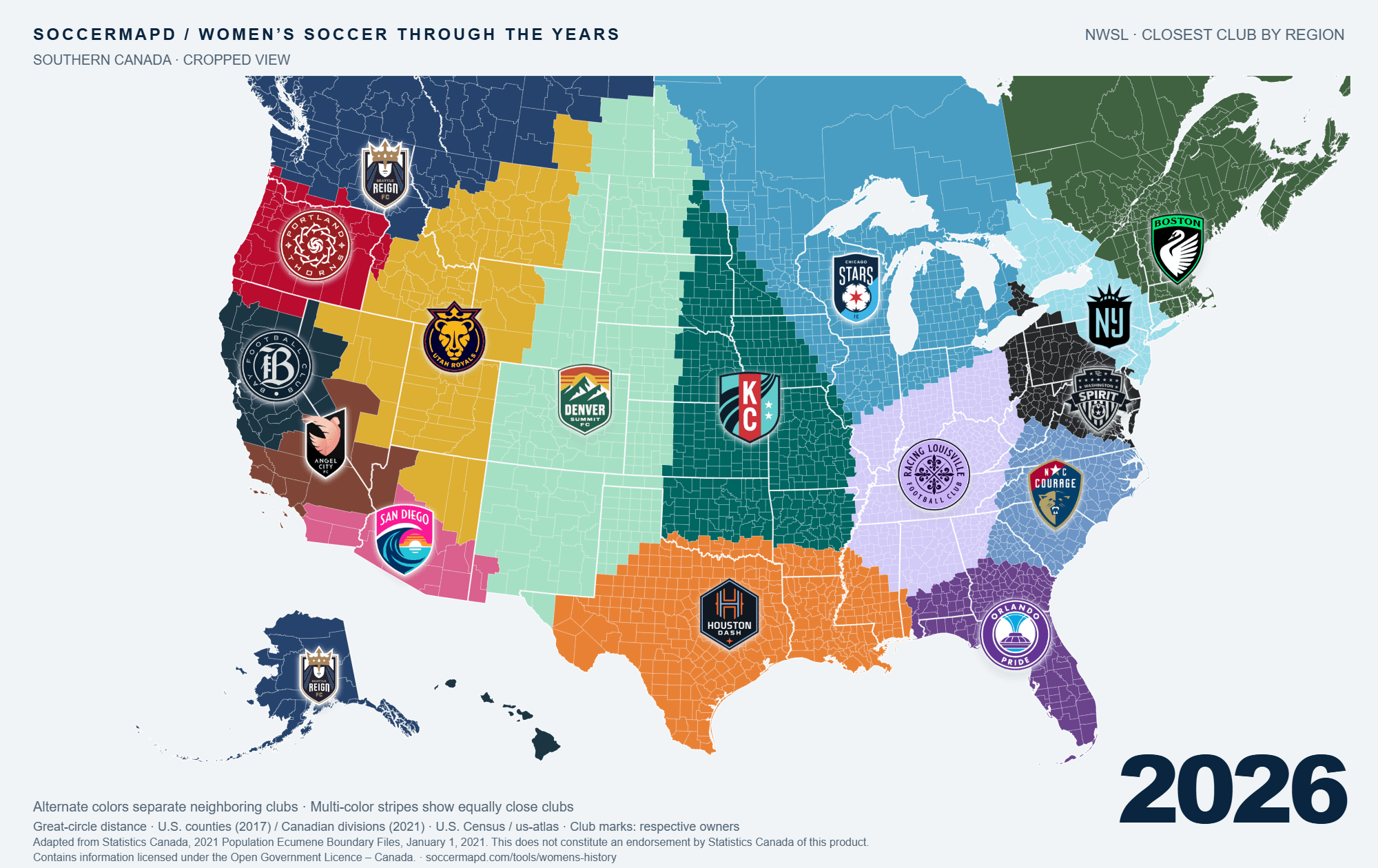
Give the women's view its own pass. A combined total can hide communities with several men's clubs and no women's professional club nearby. The women's archive begins with WUSA in 2001; earlier empty selections do not mean there was no women's soccer.
What “within reach” means here
Choose 25, 50 or 100 straight-line miles. Population comes from the Census Bureau's 2020 tract population and mean population centers. Each tract's residents are represented at one point and counted together when it falls inside the radius. This is an estimate, especially near a boundary.
Documented season grounds take priority; other clubs use approximate home-city points. Canadian clubs can reach U.S. residents, while the population covers only the 50 states and Washington, DC. This does not measure driving time, ticket affordability, attendance or support. The methodology and sources explain the limits.
The original NASL is included; the separate, revived NASL of 2011–2017 is still missing. So are MLS NEXT Pro, NISA, earlier USL predecessors and pre-2011 development seasons. Compare the same selection across years and keep those omissions in view.
Find your own chapter
Enter a hometown or ZIP in Soccer Teams Near Me Through the Years to follow nearby clubs and grounds. Explore the dedicated MLS, USL and women's history maps for each competition's story. History GIF downloads require a free account.
Then open a linked team page or the SoccerMapd map, check upcoming pro games near you, and find a match to attend.
Watch the game get closer
Explore the national soccer footprint, then find the clubs that shaped your hometown’s story.